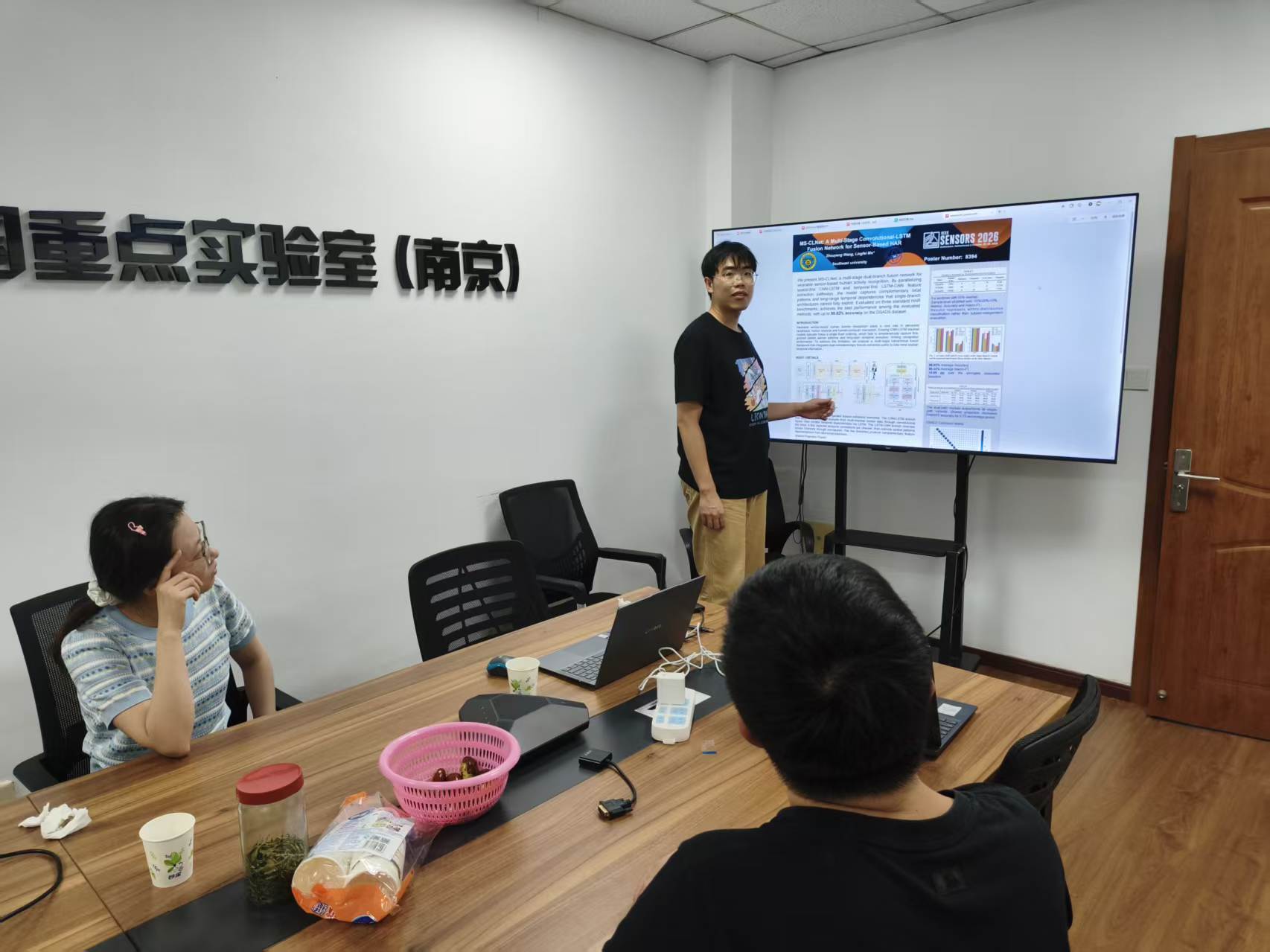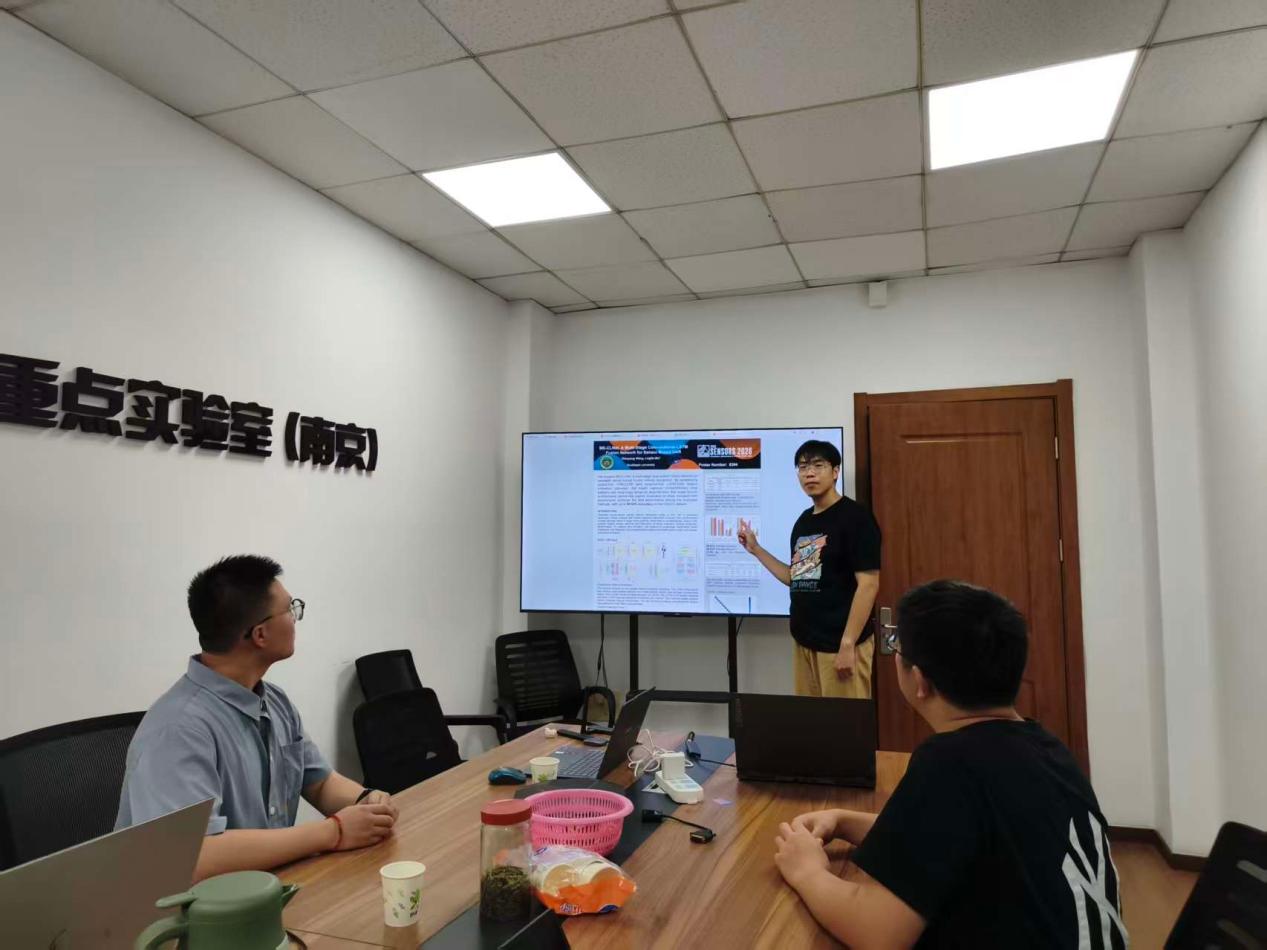

Recently, the paper titled "MS-CLNet: a Multi-Stage Convolutional-LSTM Fusion Network for Sensor-Based HAR" was accepted for poster presentation at the 2026 IEEE SENSORS Conference, to be held in Rotterdam, the Netherlands, from October 25 to 28, 2026. The work, conducted by Zhouyang Wang and Lingfei Mo at the School of Instrument Science and Engineering, Southeast University, presents a multi-stage fusion network for wearable sensor-based human activity recognition. The study addresses a central limitation of conventional CNN-LSTM models, which usually arrange convolution and recurrence in a fixed order and may not fully exploit both local cross-channel patterns and long-range temporal dependencies.
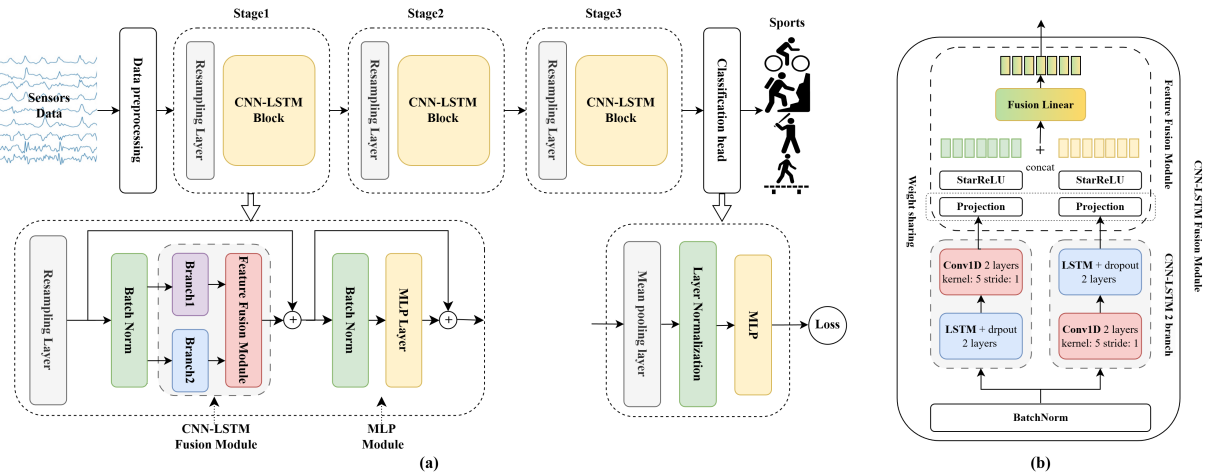
To address this limitation, the team developed MS-CLNet, a three-stage hierarchical architecture. Each stage resamples the input to a fixed channel width and applies a dual-path fusion block. The CNN-LSTM pathway first extracts local spatial features and then models temporal evolution, while the LSTM-CNN pathway processes the same sensor window from the opposite temporal-first perspective. The outputs of the two pathways are aligned through shared projection layers, concatenated, and combined through linear fusion. Residual connections retain fine-grained information during fusion. By repeating this process across three stages, the model learns complementary representations at increasing levels of abstraction.
Experiments on the DSADS, WISDM, and PAMAP2 datasets produced an average accuracy of 98.63% and an average macro-F1 score of 98.33%. MS-CLNet achieved 99.82% accuracy on DSADS and delivered the best average performance among the evaluated methods. Ablation experiments showed that the dual-path design outperformed all single-path variants, and shared projection increased PAMAP2 accuracy by 0.73 percentage points.
First author Zhouyang Wang, a PhD candidate supervised by Prof. Lingfei Mo at the School of Instrument Science and Engineering, Southeast University, led the study. Both authors are affiliated with Southeast University. The proposed framework provides a new way to coordinate spatial-first and temporal-first feature extraction for sensor-based activity recognition. Future work will examine subject-independent evaluation and efficient deployment on edge devices.