

From September 27 to October 1, 2026, the IEEE/RSJ International Conference on Intelligent Robots and Systems (IROS 2026) was held in Pittsburgh, Pennsylvania, USA. As one of the leading international conferences in robotics, IROS brings together researchers and scholars from around the world to exchange ideas and present recent advances in robotic perception, intelligent control, autonomous navigation, and embodied intelligence. Six graduate students from the School of Instrument Science and Engineering at Southeast University participated in the conference through on-site presentations and online participation, showcasing their latest research achievements in robotics and related fields.
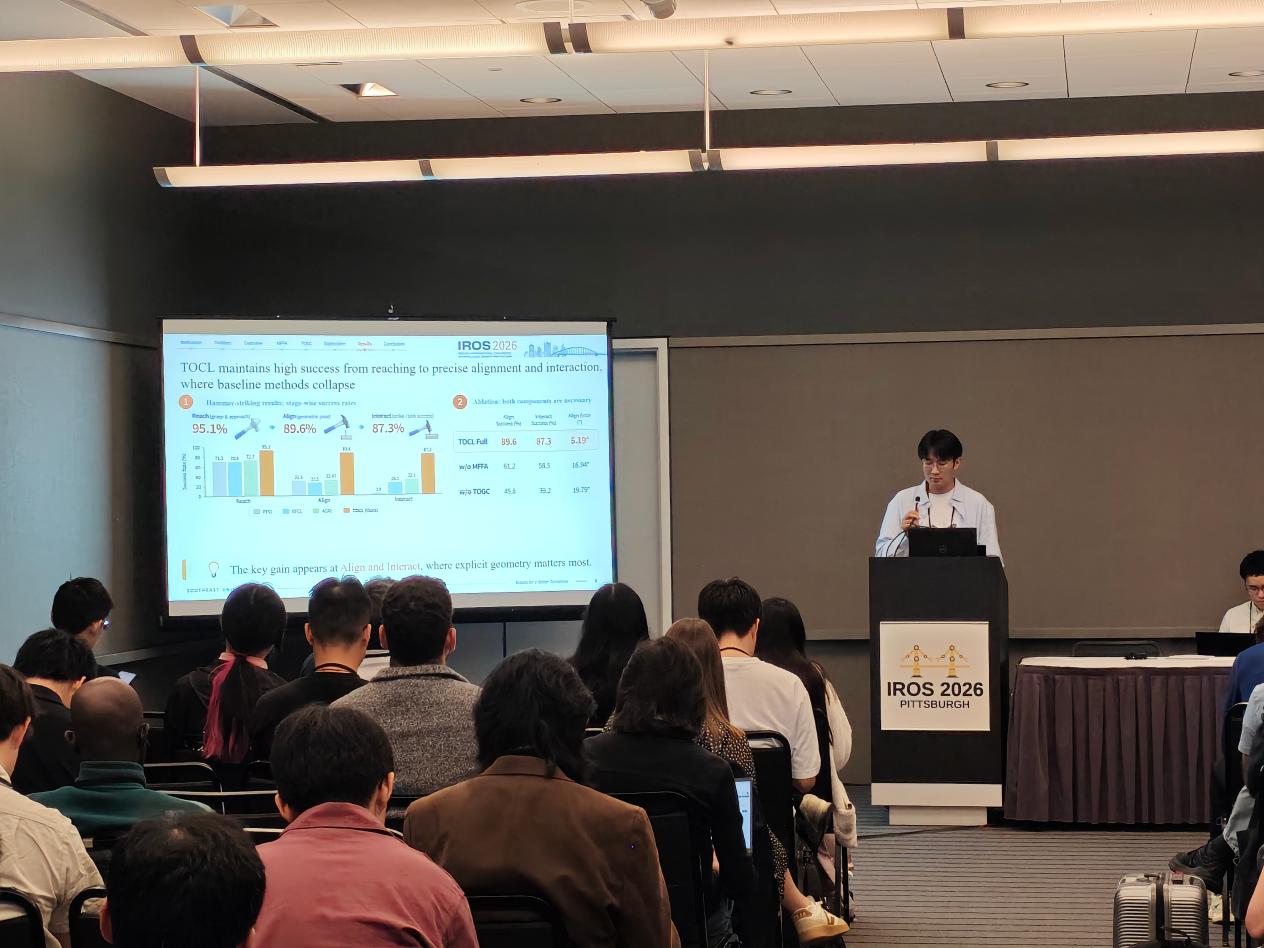
During the conference, Dongcai Liu presented a paper entitled "TOCL: Task-Oriented Curriculum Learning with Functional-Frame Alignment for Tool Manipulation." The study addresses challenges in modeling geometric constraints, improving learning efficiency, and enhancing generalization in complex robotic tool manipulation. It introduces a reinforcement learning framework that integrates functional-frame alignment with task-oriented curriculum learning, enabling unified representations of functional features across different tools and progressive skill acquisition. The proposed method achieved a success rate of 95.1% in simulation and 78% on a real robotic platform in hammering tasks.
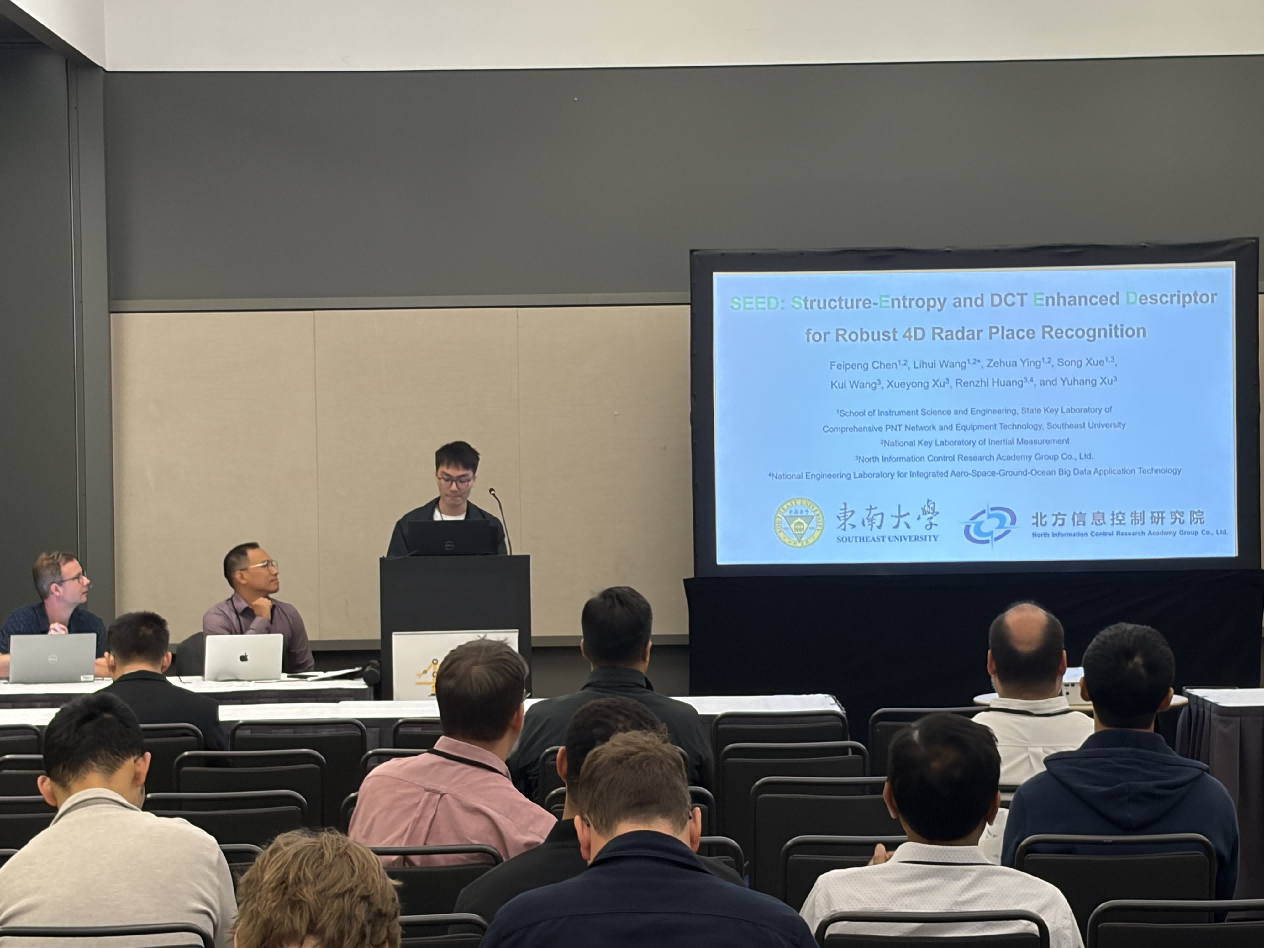
Feipeng Chen presented a paper entitled "SEED: Structure-Entropy and DCT Enhanced Descriptor for Robust 4D Radar Place Recognition." The study focuses on robust place recognition using 4D millimeter-wave radar in challenging environments. By incorporating local geometric structure entropy and the Discrete Cosine Transform (DCT), the proposed method constructs complementary feature descriptors and employs a two-stage retrieval strategy to improve recognition robustness and efficiency, offering a promising approach for loop closure detection and localization in radar-based SLAM systems.
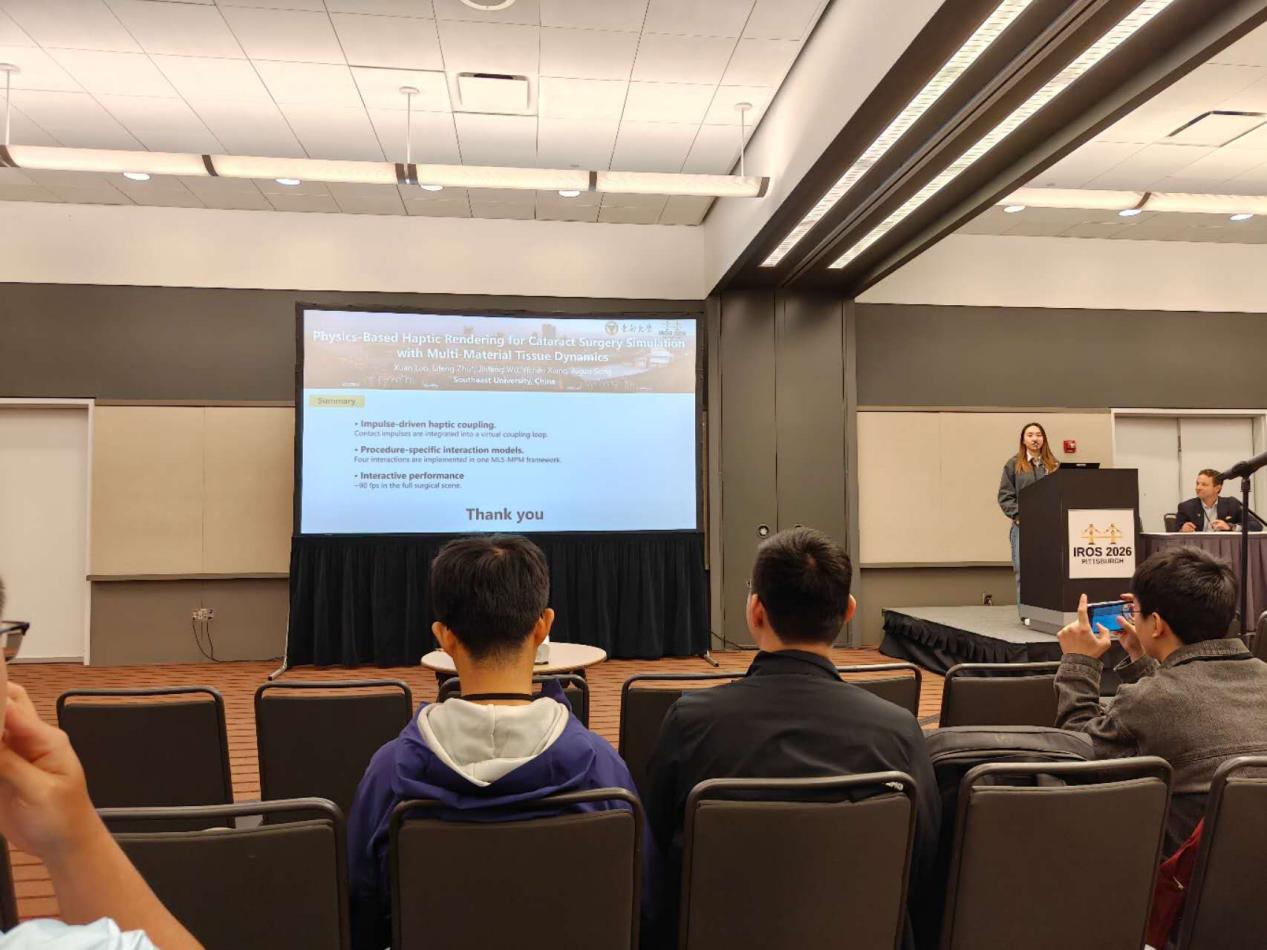
Yichen Xiang delivered a presentation entitled "Physics-Based Haptic Rendering for Cataract Surgery Simulation with Multi-Material Tissue Dynamics." The research addresses soft-tissue simulation and force feedback in cataract surgery. By combining the Material Point Method (MPM) with virtual coupling techniques, the proposed approach enables real-time simulation of typical surgical procedures and interactive haptic feedback, providing technical support for high-fidelity virtual surgical training.
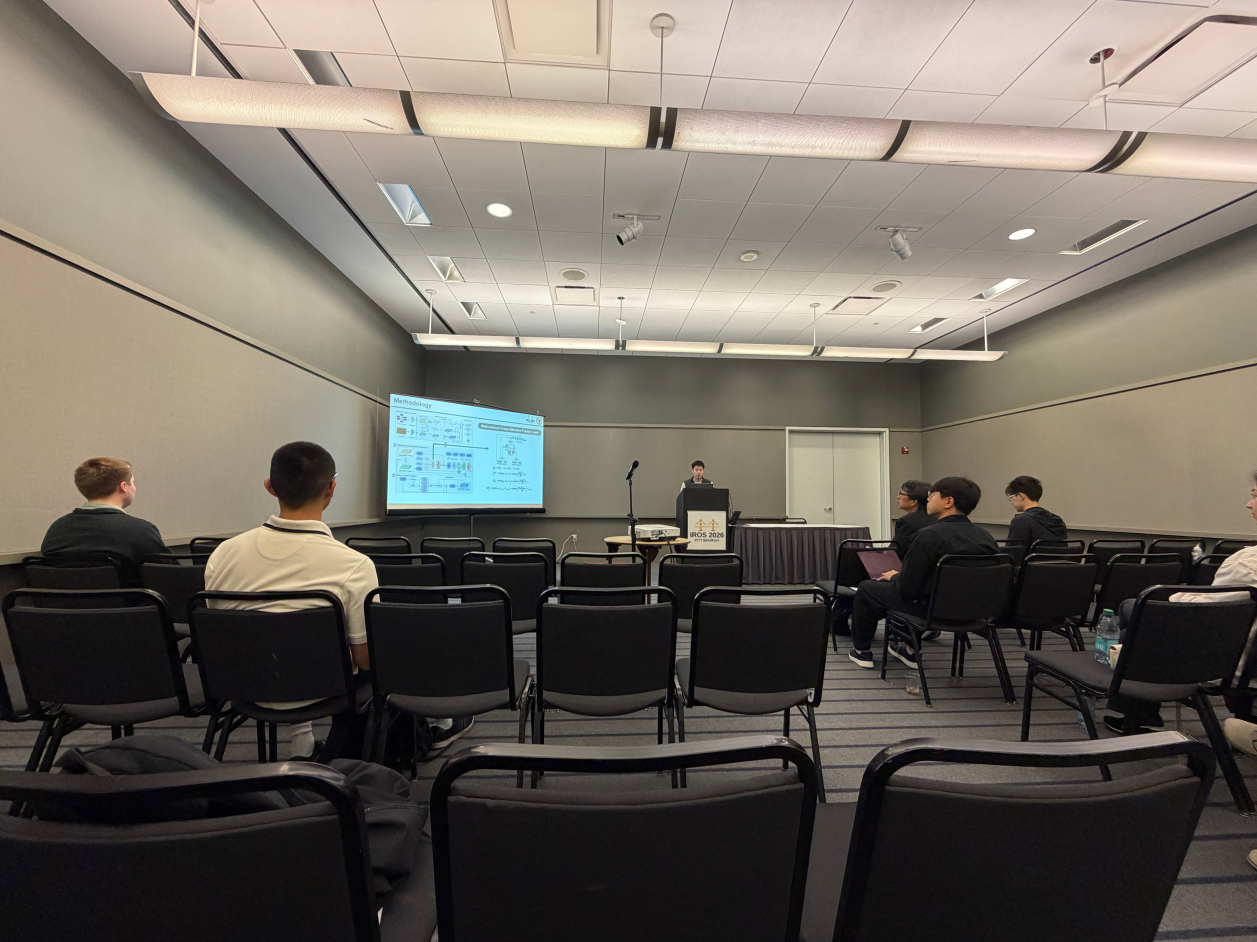
Weiming Jing presented a paper entitled "HD-Fusion: Hierarchical Dynamic Fusion of LiDAR-Camera for Robust 3-D Object Detection." The research addresses limitations in depth information representation and cross-modal feature interaction in LiDAR-camera fusion under complex driving conditions. A hierarchical dynamic fusion framework is proposed to enhance the complementarity of multimodal information through scene-level and context-level feature fusion, improving the accuracy and robustness of 3D object detection.
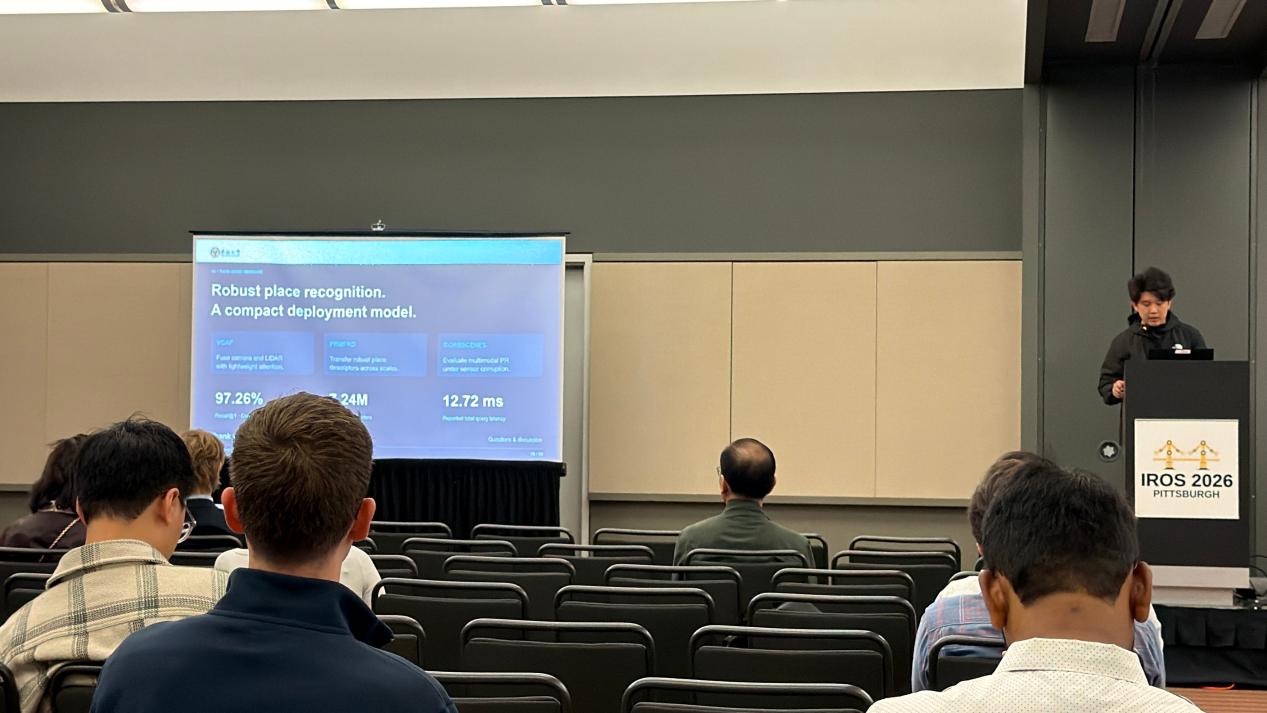
Zihang Wang presented a paper entitled "LiteFT-PR: Lightweight and Fault-Tolerant LiDAR-Camera Fusion Network for Robust Place Recognition via Model Distillation." The study focuses on robust place recognition under sensor failures and the challenges of lightweight model deployment. It proposes a knowledge-distillation-based LiDAR-camera fusion network that incorporates multi-stage feature knowledge distillation and vertical content-aware fusion, enabling lightweight and robust place recognition under challenging sensing conditions.
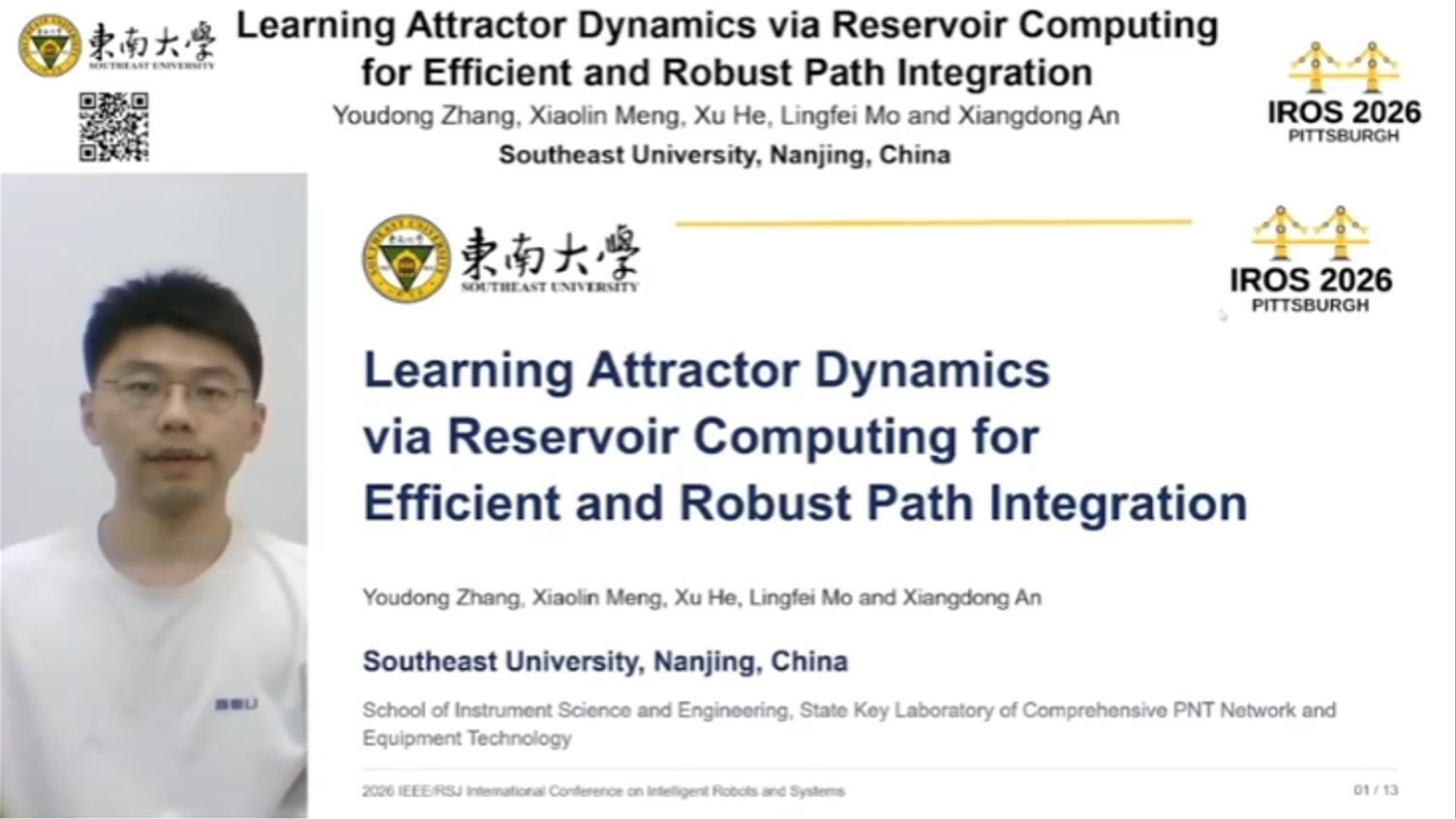
In addition, Youdong Zhang delivered an online oral presentation entitled "Learning Attractor Dynamics via Reservoir Computing for Efficient and Robust Path Integration." To address the high computational cost of continuous attractor neural networks in brain-inspired navigation for mobile robots, the study proposes an efficient path integration method based on reservoir computing. By incorporating representation learning to capture attractor dynamics, the proposed method enables efficient modeling of grid cells and head-direction cells, improving computational efficiency and trajectory estimation robustness.
Throughout the conference, the participating graduate students actively engaged in technical sessions and academic discussions, exchanging research findings and insights with researchers from around the world. Their participation highlighted the School's research achievements in robotic perception, intelligent manipulation, and autonomous navigation. The conference also provided valuable opportunities to broaden academic perspectives, strengthen international exchanges, and foster future research collaboration.