
Recently, the 25th IEEE SENSORS 2026 has accepted the paper titled “Evolution of Thermomechanical Stress in a Monolithic Quartz Vibrating Beam Accelerometer from Packaging to Operation,” The work, led by Prof. Jinxing Liang’s team at the Key Laboratory of Micro-Inertial Instrument and Advanced Navigation Technology of Ministry of Education and the State Key Laboratory of Comprehensive PNT Network and Equipment Technology, School of Instrument Science and Engineering, Southeast University, investigates thermomechanical stress evolution and conducted a failure analysis in a monolithic quartz vibrating beam accelerometer (QVBA) from packaging to low-temperature operation.
Although a monolithic quartz structure offers favorable temperature stability, conductive adhesive joints connecting the chip to its ceramic package can transfer thermomechanical loads and create localized stress. To examine the effects of successive manufacturing steps, the researchers developed a 3D process-history-dependent thermomechanical model. The model follows the device through adhesive curing, vacuum sealing, and low-temperature operation, carrying residual stress, deformation, and adhesive state from one stage to the next.
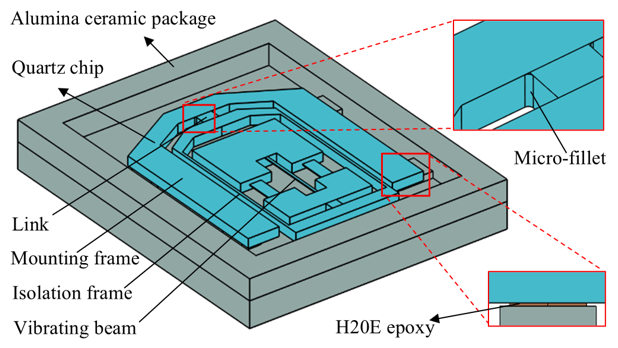
At −40 °C, the process-history model predicted a local stress of 136.1 MPa, compared with 45.2 MPa from a model that treated each stage independently. This difference highlights the influence of inherited process state on the final stress prediction under the conditions studied. In sequential testing of 40 specimens, 13 fractured after curing; 7 fractured after sealing; and none of the remaining 20 fractured during low-temperature testing. All the observed crack initiation locations corresponded to the predicted stress hotspot. The stage distribution of failures did not align with the stage of peak predicted stress, suggesting that moisture-assisted crack growth may have contributed to the observed failure pattern. This study provides a basis for identifying failure-critical regions and evaluating adhesive-joint geometry and packaging thermal profiles.
First author Shengshou Lin, a PhD candidate in Prof. Jinxing Liang’s group, led the work. Southeast University is listed as the corresponding affiliation, and the study was funded by the Fundamental Research Funds for the Central Universities.