

Recently, the 25th IEEE Conference on SENSORS has accepted the paper titled "Femtosecond Laser-induced Chemical Etching for Suppressing Anisotropic Wet Etching Defects in Quartz-Based MEMS Fabrication," The work, led by Prof. Liang Jinxing's team at the Institute of Micro-Nano Devices and Intelligent Microsystems, School of Instrument Science and Engineering, Southeast University. The work proposes a Femtosecond Laser-Induced Chemical Etching (FLICE) technology specifically designed to address the core challenge of crystal edge defects caused by crystal anisotropy in traditional wet etching, thereby improving the fabrication precision and performance of quartz MEMS devices. For context, IEEE SENSORS is a highly influential international academic conference in the sensor field, covering multiple research directions such as physical sensing, biosensing, micro-nano devices, and inertial measurement. It brings together experts and scholars from universities, research institutions, and industry worldwide to showcase the latest research achievements in sensor technology and its applications.
The fabrication of quartz MEMS devices is often limited by the anisotropy of traditional wet etching, which leads to the formation of crystal edge defects on sidewalls and corners, affecting the geometric precision and vibration characteristics of the devices. To address this issue, the team developed a fabrication method based on FLICE. This technology utilizes an etching selectivity ratio of approximately 5:1 between laser-modified and unmodified regions, allowing the etching process to be dominated by the laser-modified regions rather than governed by the quartz crystal orientation, thereby effectively suppressing the formation of crystal edges.
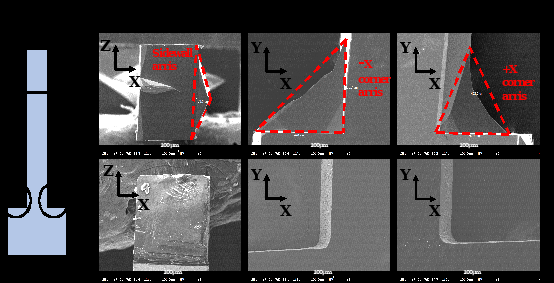
In experimental validation, the method demonstrates marked improvements: the structural vibration frequency deviation was reduced from 15% in traditional wet etching to 0.7%; the parasitic out-of-plane vibration amplitude under in-plane bending vibration decreased from 87.3 nm to 3.3 nm, showing a significant suppression effect. This fabrication method significantly improves the geometric precision of the devices and reduces process-induced errors, providing a new technological pathway for the fabrication of high-performance quartz MEMS resonators and sensors.
First author Feihu Fang, a PhD candidate in Professor Jinxing Liang’s group, led the work and presented an oral report on behalf of the team at the conference. Southeast University is listed as the first and corresponding affiliation.